
Chesapeake, Ohio Nightclub: Continental Nite Club, aka Continental Club; aka Club Continental
A Brief History of Chesapeake
In 1815, before Lawrence County, Ohio, was formed from Gallia County, Ohio, the area around Chesapeake was known as the community called "Washington." After Lawrence County began to form, the community was called Kounston, with Symmes Run as the Post Office, named after Andrew Kouns, one of the first settlers.
Then, on 2 March 1867, when James Frampton became the postmaster, he changed the name to Frampton. On 11 May 1874, as the area grew, the eastern part of the community's name was changed to Rockwood (the eastern part starting at the Symmes Creek bridge). The western part of Chesapeake (starting at the Symmes Creek Bridge) was called Lawrence City.
Flemingsburg – was located west of Symmes Creek. It was named after Fleming Booth, an old resident of that place, who was the blacksmith in an older town than Rockwood.


Photos courtesy Randall Lewis, as credited in the original article. Newspaper feature and individual photographer details have not been fully established.
Approximately ten years ago, William and Howard Swartz went to Chesapeake, Ohio, where they operated the Continental Club, but in 1949, Ohio refused to renew a liquor permit for the Club. In its application, the Continental Club alleged that it was run by the Chesapeake Operating Co. and named as its officers Jack Goodman, 2952 Hampshire Road, Cleveland, as president; A. E. Giessey, vice president; and E. W. Sauers, secretary.
These men, Giessey and Sauers, had been the accountants for the Cleveland syndicate. Jack Goodman is an ex-prize fighter and has been associated with Thomas Jefferson McGinty's operations for many years. Giessey is an accountant representing the Pettibone Club operated by the Cleveland syndicate, and Sauers is an accountant in the same office.
In the fall of 1949, William Swartz, Howard Swartz, and one James Dougherty moved into West Virginia and began remodeling a place in Huntington, W. Va., for gambling purposes. According to authorities in West Virginia, the same group is allegedly engaged in gambling operations in Clarksburg, Parkersburg, and Wheeling, W. Va., to all appearances. These operations are those of the Cleveland syndicate.
Allegations have been made that Licovoli has been a part of the powerful gambling combination, including Moe Davis, Maurice Kleinman, Lou Rothkopf, and others. The Jungle Inn is located in Trumbull County and is said to be operated by the Licovoli gang. Licovoli has become extremely wealthy, and it is claimed that he was interested in other gambling establishments, such as the Pettibone Club, Brady Lake, and Chesapeake Club, several years ago. He was also in charge of all the slot machines in Lake, Geauga, and Trumbull Counties, Ohio.
CONTINENTAL CLUB TIMELINE
Newspaper 9 Aug 1945
Mayor Hears Ouster Threat – Gov. Lausche Orders Chesapeake Cleanup – Gov. Lausche today ordered Mayor R. L. Hamilton of Chesapeake to clean up alleged gambling at the Continental Casino in the Lawrence County village or be removed from office.
Hamilton and Lawrence County Sheriff Milton B. Rucker promised they would cooperate to end gambling in the community. Lausche said, “the matter is left in abeyance to see if the abuses will be remedied.”
Liquor Director Robert M. Sohngen sat in on the conference. Lausche said the Casino was now housed in a new building erected by receipts from the Continental Club to evade revocation of the Continental Club’s liquor license on gambling charges. Lausche said that he would not consider such a separation as a severance of the management or an excuse to keep a license.”
Newspaper 29 Apr 1948
– Judge Warns About Crime If Gambling Continues. – Ironton, April 29 – Common Pleas Judge James H. Collier fears something “far more serious” than a $100,000 robbery may occur at nearby Chesapeake if, he said, establishments are permitted to operate in violation of the law. Last night, the judge told a newsman about the early Monday morning holdup of a casino west of the Club Continental. … $100,000 robbery by ten bandits of customers and management representatives at the casino…
Newspaper 19 June 1948 – Kentuckian’s Suit Settled
Reuben L. Gordon, Hazard, Ky., against the Continental Nite Club Inc., and William and Howard Schwartz, officers of the club, Chesapeake, Ohio, for $41,133.76 as damages for injuries Gordon alleged he received when ejected from the club on July 2, 1945, was dismissed by Judge Druffel.
Newspaper 28 Jan 1949 – Files Gambling Suit
Ironton, Ohio, Jan 28 – F. A. Copenhaver, Huntington, WV, filed a common-law suit seeking a judgment of $5,100 against the Continental Night Club, Chesapeake, Ohio. Copenhaver charged he lost that amount at gambling at the club between Dec. 12 and 19, 1948.
Cincinnati Enquirer 13 Mar 1949 – Four Clubs Are Hit Bitterly In Bid For Executive Power to Pounce. None of the Places Named Is in Cincinnati, But Drive Only Begins.
“Admittance to the place,” stated Gov. Lausche, “is supposedly given to members and persons who come properly recommended. Children have been seen in the company of players at the Continental Club.”
“Patrons who enter the Continental Club are observed without their knowledge in a rather scientific way. An attendant is at the entrance, through a scientific arrangement of mirrors, and finally, a peephole in the inner door. He can see what is going on outside.”
“The deluxe, plush gaming houses attempt to provide every comfort to their patrons. The clubs have overstuffed chairs and divans. Valets and maids attend the men’s and women’s lounges. Cosmetics are free in the women’s lounge,” Lausche said the Continental Club “has 45 slot machines … dice, blackjack tables, and race returns. Children have been seen in the place in the company of the players. All types of gambling devices are available at these places – dice tables, blackjack, chuck-a-luck, roulette tables, poker games, and horse racing.
Governor Lausche denounced the “multi-million-dollar-a-year racket” to gain support for two proposed laws that would give him the power to curb gambling in the state. One of the bills would empower the Governor to remove sheriffs who fail to perform their duties. The other bill would authorize a County Prosecutor or the State Attorney General to padlock gaming establishments.
He first targeted four clubs where “commercial gambling of every type was in existence.”
- Pettibone Club in Bainbridge Twp., Geauga County
- Jungle Inn, Liberty Twp., outside Warren in Trumbull County.
- Club Continental on Route 52 at Chesapeake in Lawrence County.
- Mounds Club on Route 6, about 4 miles from Willoughby in Lake County.
Newspaper 24 Oct. 1949
– Gambling Spot Denied D-5 Permit – The state liquor department refused to renew the D-5 night club permit of the Continental Club, famous Lawrence County gambling joint.
Related Colony Club Proceedings — March 7, 1950
Sandusky Register, Sandusky, Ohio, March 7, 1950, page 9.
Lausche Charter Says Casino Not Charitable As Instituted
COLUMBUS, March 7 (UP) —The attorney general today prepared a suit for filing in the state supreme court to revoke the charter of the Colony Club, Lawrence County gambling casino incorporated as a "charitable" organization.
Gov. Frank J. Lausche ordered the attorney general to take action. It was Lausche's latest step in a campaign to put the "racketeering gambling" club, as the governor called it, out of business.
Lausche promised Atty. Gen. Herbert S. Duffy that whatever funds were needed would be provided. Duffy said the action to revoke the club's charter would be filed by his chief counsel, William C. Bryant, within a few days. The attorney general said investigators would be sent to Chesapeake, Ohio, and Lawrence County, Ohio, where the club is located.
Raid Last December
Last December, the state liquor department raided the Colony club and confiscated about 40 slot machines. Lawrence County Common Pleas Judge James Collier deputized state Liquor Enforcement Chief A. A. Rutkowski to make the raid effective.
Court action is pending in the Supreme Court due to the raid. The club's operators are seeking to compel Chief Justice Carl V. Weygandt to disqualify Judge Collier from hearing litigation involving the confiscated slot machines and the club.
The club charter states that it was formed to "provide for and establish funds for charitable distribution to causes beneficial to citizens of Chesapeake and Union township of Lawrence County, Ohio."
To Proceed Promptly
Lausche declared in a letter to the attorney general that "to me, it is established that the Colony Club is not a charitable or benevolent institution, but a plain, outright racketeering gambling institution."
Atty. Gen. Duffy said his department will "proceed promptly as directed by the Governor and institute quo warranto proceedings in the Supreme Court."
"I will send investigators into the county a day or so after the legal proceedings have started. The investigators will probably also take depositions from persons familiar with the club's activities," Duffy said.
The Colony Club was incorporated on June 1, 1949, and listed on the corporation papers were Willard P. Rollyran, Huntington and Curtis Wilson, and Thomas Fuller, both of Chesapeake.
Gov. Lausche assured the attorney general that "whatever funds will be needed to prosecute this litigation to an end and completely reveal the illegal operations of the club will be provided."
It was indicated that Lausche planned to ask the state controlling board to release any needed funds.
Newspaper 3 Mar 1953
– Damage Suit Settled – A $15,000 damage suit filed by Ernest Kincade, Huntington, WV, against the Continental Nite Club, Chesapeake, Ohio, was dismissed at the defendant’s cost by Judge Druffel after the parties reported they had compromised. The damages resulted from a traffic collision in Nov. 1949 as the plaintiff drove from the defendant’s parking lot under the direction of the defendant’s attendant.
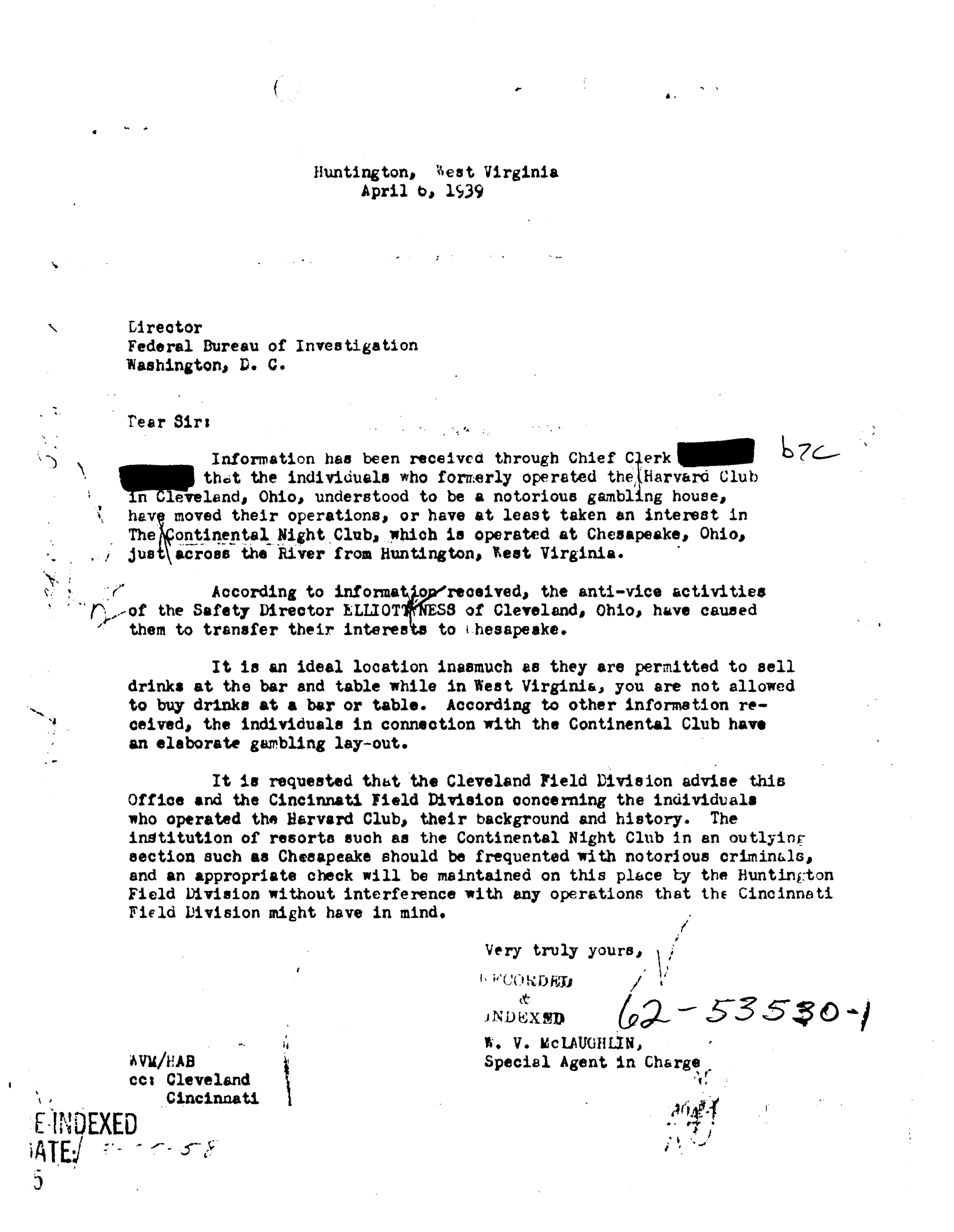
FBI Correspondence
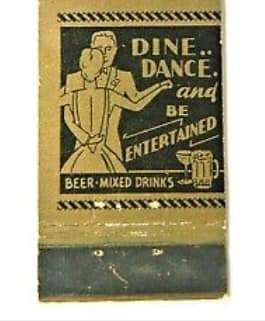
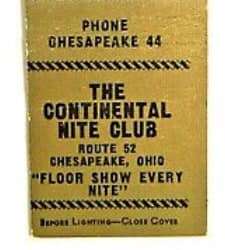
Continental Nite Club Matchbook
Editor’s Note
This article combines a local-history introduction, an undated narrative, dated newspaper excerpts, photographs, FBI correspondence, and matchbook images. The Continental Club, Continental Nite Club, and Club Continental are names used in the supplied material. The nearby Colony Club is discussed separately in the March 7, 1950 report. That report should not be read as establishing that the clubs were the same corporation.
The surnames Swartz and Schwartz occur in different portions of the supplied text and have been retained rather than assumed to be interchangeable. “Licovoli,” “Moe Davis,” “Maurice Kleinman,” and “Willard P. Rollyran” require comparison with original records before any name corrections or identity conclusions. The undated phrase “approximately ten years ago” cannot be assigned an exact starting year. Several entries are labeled only “Newspaper” and lack a publication title or page number; those citations remain incomplete.
The brief account of Chesapeake’s early settlements and post-office names should be checked against the documented chapters of The Early History of Chesapeake, Ohio. It compresses several settlements into a sequence and should not be treated as proof that Washington, Kounston, Symmes Run, Frampton, Rockwood, and Lawrence City were all successive names for exactly the same place. The linked Andrew Kouns page also requires verification before using it to identify the early settler mentioned here.
Historical statements about gambling, ownership, and organized-crime connections are allegations or assertions in the supplied accounts and correspondence. The article does not provide final judgments for every proceeding. The March 1950 report says “about 40” slot machines, while the December 1949 Colony Club accounts report 45; the differing source wording is retained. The 1948 item’s “Suit Settled” heading is preserved, but its text alone does not explain the terms of any settlement.
The original FBI image and both matchbook images have been retained. The investigative letter reports information and allegations; it is not a court judgment. Image credits are reproduced as supplied, and ownership or permission for book reproduction has not been independently established.