
A Lawrence County, Ohio, Case That Reached Ohio’s Death Chamber
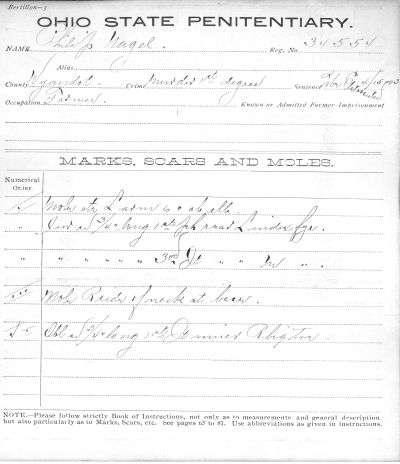
Ohio State Penitentiary identification form for Phillip Nagle, Register No. 34554. The record identifies him as a farmer, convicted in Wyandot County of murder in the first degree and sentenced to be electrocuted.
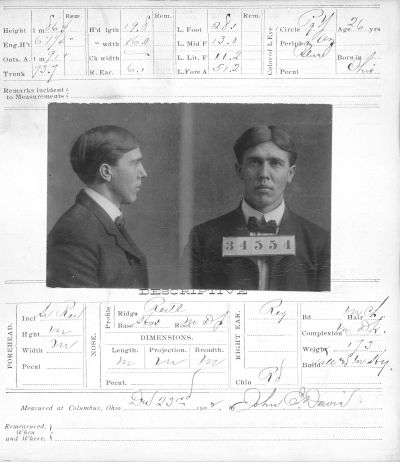
Phillip Nagle, Ohio State Penitentiary Bertillon identification photograph, measured at Columbus, Ohio, Dec. 23, 1903. The prison record notes that Nagle, age 26, was born in Ohio and had blue eyes.
Phillip Nagle and the William Wade Murder Case
The case of Phillip Nagle is one of the more dramatic criminal cases connected with Lawrence County, Ohio, in the early 1900s. What began with the discovery of a murdered man near Upper Sandusky, Ohio, grew into a sensational murder prosecution, a death sentence, repeated reprieves, years under sentence of execution, and, eventually, commutation and reported pardon. This story is full of twists and turns, even involving Nannie Kelley Wright, who, according to her obituary, was reputed to have been one of the richest women in America.
Two surviving prison record images help place the case in a more personal and human light. Nagle’s Ohio State Penitentiary Bertillon photograph and identification sheet, made in December 1903, preserve the face and physical description of a man whose name had already filled newspaper columns across Ohio. The records identify him as Phillip Nagle, a farmer, convicted in Wyandot County of murder in the first degree, and sentenced to die in the electric chair.
Because much of what survives in public memory comes from old newspapers, the case must be read carefully. Early newspaper reports often presented accusations as fact, while later accounts cast doubt on the certainty of Nagle’s guilt. Even so, the articles together preserve the outline of a remarkable Ohio case with ties to Lawrence County.
The Killing of William Wade
The story begins with newspaper coverage in November 1902, when reports stated that Phillip Nagle, associated with Chaffins Mills in Scioto County, was being held in the Lawrence County, Ohio, jail in connection with the death of William Wade of Hecla, Lawrence County. I was able to verify that Phillip was indeed incarcerated in the Lawrence County, Ohio, jail by going through the original jail register. You can find those and other names in my books on amazon. According to the jail record, Nagle was only in the jail in Lawrence County, Ohio, for one day, on 31 October 1902 and was extradited by the Wyandot County, Ohio, sheriff’s office on 1 November 1902.
Wade’s body had been found near Upper Sandusky, Ohio, hidden beneath railroad tracks in a culvert. One early newspaper account called Nagle the “confessed murderer” of Wade. Like many crime reports of the era, the language was direct, dramatic, and highly sensational.
Other accounts added that Wade had recently come into possession of money, which was said to be missing when his body was discovered. Nagle was described as the last person known to have been with Wade, a fact repeatedly emphasized in later newspaper reports.
Conviction and Death Sentence
By 1903, Nagle had been convicted of murder and sentenced to death. Newspaper reports from Columbus stated that he was among the condemned men then housed in the Ohio Penitentiary. One article described the death chamber as filling with prisoners awaiting execution and listed Nagle among them.
The prison identification record adds important detail to this stage of the case. It shows that Nagle was received at the Ohio State Penitentiary under Register No. 34554. The form gives his county as Wyandot, his occupation as farmer, and records the sentence as “to be electrocuted.” The date on the descriptive photograph appears to read December 23, 1903, preserving a stark visual record of his entrance into the state prison system.
At that stage, the newspapers treated the case as largely settled. Reports described Nagle as one of several dangerous men condemned to die in the electric chair. His sentence had apparently been set in the spring of 1903, though his execution was delayed while the case was reviewed. This delay proved important. Although the conviction stood, Nagle’s execution did not proceed immediately, and his case remained active in both the courts and the public press.
A Rare Physical Description
The Bertillon-style prison record provides details that ordinary newspaper coverage rarely preserved. The form indicates that Nagle was 26 years old, born in Ohio, with blue eyes and light-colored hair. His weight appears to be recorded as 173 pounds, and his build as slim and sturdy. The record also lists several physical marks and scars, including scars on the fingers and a mole or mark on the neck.
For family historians and local researchers, these details are especially valuable. They transform Phillip Nagle from a name in sensational headlines into a documented individual described in the routine language of prison administration.
The Penitentiary Years
While awaiting execution, Nagle remained at the Ohio Penitentiary. In June 1904, his name appeared again in newspapers after an attempted escape by condemned prisoners. According to the report, Phillip Nagle, along with Moses Johnson, Louis Harmon, and Ben Wade, tried to overpower a guard in the annex where condemned prisoners were held. The guard was badly beaten before other guards came to his assistance and forced the men back into their cells.
This story illustrates just how long Nagle remained under sentence of death. He was not carried quickly to execution, but instead spent months, and eventually years, living in the uncertainty of repeated delays.
Appeals, Reprieves, and the Board of Pardons
In November 1904, newspapers reported that the Ohio Supreme Court had refused to interfere with the death sentences of Phillip Nagle and another condemned man, William Nichols. Even so, Nagle received a further reprieve from Governor Myron T. Herrick, postponing his execution until December 23, 1904, so that the Board of Pardons could consider his case.
At the start of December 1904, the Board of Pardons reportedly rejected the applications of both Nichols and Nagle for commutation of sentence. One newspaper noted that efforts were being made to change Nagle’s execution date because the scheduled date would cause his body to arrive home at Christmas if he were executed as planned.
Despite these reports, Nagle was not put to death. For reasons reflected more clearly in later newspaper accounts, his sentence was ultimately not carried out.
Mrs. Nannie Wright’s Intervention
A newspaper article published in 1912 credited Mrs. Nannie Wright of Ironton with playing a key role in saving Nagle from execution. According to that account, she had known him since childhood and personally appealed to Governor Herrick when he was reportedly only hours away from the electric chair. The article said her intervention helped secure temporary reprieves and, in time, the commutation of Nagle’s sentence from death to life imprisonment.
This later article matters because it is the point where the story begins to feel almost miraculous. Earlier newspaper reports assumed guilt and focused on punishment. The 1912 article instead emphasized uncertainty, mercy, and the possibility that the conviction rested on evidence less conclusive than first presented.
Nagle’s Version of Events
By 1912, newspaper retellings included Nagle’s own explanation of what had happened. According to that version, he and William Wade had gone from Ironton to Wyandot County to cut corn. When they attempted to return home, they reached Upper Sandusky too late to catch a regular southbound train and tried instead to catch freight trains.
Nagle said that two freight trains were leaving at nearly the same time. He claimed he ran past one headed north and boarded one headed south, believing Wade was following behind him. According to this account, he did not realize Wade had not boarded with him until he reached Marion. He then went on to Ironton and only later read that Wade had been murdered and that suspicion had fallen on him.
The same article stated plainly that Nagle had been convicted on circumstantial evidence. That is a very different impression from the early report calling him a confessed murderer, and it serves as a reminder that newspaper accounts can vary sharply depending on when and where they were written.
Life Imprisonment and Reported Pardon
According to The Marion Star in December 1912, Nagle had by then spent years in prison and had become a cook on the prison honor squad. The article reported that, although not yet formally announced, a pardon by Governor Harmon was expected and was considered almost certain.
If correct, that marked an extraordinary turn in a case that had once placed Nagle in the death chamber awaiting execution. From condemned prisoner to life inmate to likely pardoned man, the story was one of the more unusual criminal cases tied to Lawrence County residents in that era.
Mattie Bentley (Beatty) and the Sensational Press
Another chapter in the public story of Phillip Nagle appeared in an April 1905 newspaper article about Mattie Bentley (other spellings of her name are Bently and Beatty). According to that report, she attended Nagle’s trial faithfully and later vowed either to secure his release or commit a crime that would place her in prison near him. The paper claimed she eventually committed a felony in Ironton and, upon entering prison, expressed concern only for Nagle’s welfare. What crime did she commit? According to the newspaper from Marion Star, 8 April 1905, Maggie enticed a young girl under the age of eighteen years of age into a resort at Ironton, Ohio. Maggie must have been sentenced from other area than Lawrence County, Ohio, as she is not recorded in their jail registers.
Whether every detail was accurate or embellished, this article reflects the sensational style of early twentieth-century newspapers. Crime reporting often blurred the line between fact, rumor, and dramatic storytelling. For that reason, such articles are valuable, but they should always be used with caution.
Why the Case Still Matters
| Connected several Ohio places | The case tied together Lawrence County, Scioto County, Wyandot County, Marion, and Columbus, Ohio, courts in one criminal matter. |
| Shows how newspapers worked | Newspaper stories from that time show how quickly a suspect could be treated as guilty before every question had been fully settled. |
| Explains mercy in Ohio law | The case shows that even after a person was sentenced, the government could still step in and change what happened next. A delay, a lighter sentence, or a pardon could keep someone from being executed. |
| Warns researchers to be careful | Because the reports changed over time, the case reminds historians that stories based on circumstantial evidence were often told differently in different years. |
| Adds value through prison records | The penitentiary photographs and descriptive record make the story more valuable because they are original records created while the case was still unfolding. |
| Shows the full picture | When the newspaper stories and prison photos are looked at together, they help explain both what happened in Phillip Nagle’s case and how public opinion changed over the years. |
Source Notes
The following newspaper items form the basis of this summary:
- “Confessed the Killing,” Sidney Daily News (Sidney, Ohio), 1 Nov. 1902, p. 3.
- Reported that Phillip Nagle was held in the Lawrence County jail for the murder of William Wade of Hecla, Lawrence County, whose body was found near Upper Sandusky.
- “Death Chamber Will Be Crowded,” The Stark County Democrat (Canton, Ohio), 12 June 1903, p. 5.
- Reported that Nagle was among the condemned men in the Ohio Penitentiary and summarized the case against him.
- “Attempt to Break Ohio Penitentiary,” The Fort Wayne Journal-Gazette (Fort Wayne, Indiana), 14 June 1904, p. 1.
- Named Nagle among four condemned prisoners involved in an attempted escape.
- “Herrick Refuses to Delay Sentence,” The Times-Democrat, 25 Nov. 1904, p. 1.
- Reported that the Ohio Supreme Court refused to interfere, but that Governor Herrick granted Nagle a reprieve to Dec. 23, 1904.
- “To Change Execution Date,” The Times Recorder (Zanesville, Ohio), 25 Nov. 1904, p. 3.
- Reported efforts to adjust the date of Nagle’s electrocution.
- “Death Sentence Stand,” The Fort Wayne Sentinel, 3 Dec. 1904, p. 8.
- Reported that the State Board of Pardons denied commutation for Nagle and William Nichols.
- “Mattie Bently Fulfills Threat,” The Marion Star (Marion, Ohio), 8 Apr. 1905, p. 6.
- Described Mattie Bentley’s devotion to Nagle and her later imprisonment.
- “Taken From Shadow of Grim Prison Walls,” The Marion Star (Marion, Ohio), 24 Dec. 1912, p. 8.
- Gave a retrospective account of the case, credited Mrs. Nannie Wright with securing reprieves and commutation, and stated that a pardon for Nagle was expected.
- “Sheriff’s Jail Register, Book Two, 1892 – 1910, From Lawrence County, Ohio,” writted by Martha J. Martin-Kounse.
- Ohio State Penitentiary Bertillon identification photograph and descriptive record for Phillip Nagle, Register No. 34554, measured at Columbus, Ohio, Dec. 23, 1903.
- Records Nagle’s physical description, age, birthplace, occupation, conviction in Wyandot County for first-degree murder, and sentence to electrocution.
Research Note
Because these accounts come from newspapers published over ten years ago, details do not always agree. Early reports were highly sensational and sometimes stated conclusions as facts. Later reports emphasized circumstantial evidence and possible injustice. Anyone pursuing the case further should compare these articles with court records, penitentiary records, pardon records, and local county records, wherever available.
0 Comments