
Discover the Rich Tapestry of Crown City
Originally Written by R. C. Hall, The Herald-Dispatch, March 27, 1938. [Rewritten by Martha J. Martin, using Grammarly for clarity, this was NOT written using AI.]
Uncover the fascinating history of Crown City, Ohio, from its rugged beginnings to its vibrant present. Join us on a journey through time as we delve into the events and people that shaped our community.
The Birth of Crown City
From our earliest recollections, we now know something about Crown City, Ohio, but for many years had no intention of making our home here. The first time we ever saw the place was on a beautiful spring morning in 1910.
We were mere boys, then and as we stood on the boiler deck of the old steamer C. C. Boyer and looked up to the top of the precipitous riverbank, all we could see of the town was the top of a house or so what appeared to be the ruins of one or two other buildings from under which the hungry stream had eaten the earth in years.
Not long after that, we passed through the town by road, but as the driver of the automobile on which we were riding appeared more interested in speed and scenery, we could not gain a very satisfactory impression of the place.
However, as we recall, and several subsequent trips of the year immediately following, the thing that impressed us most with the place was the roughness and muddiness of the road.
These experiences gave us a somewhat unfavorable impression of Crown City. Or perhaps, they merely added to an already favorable impression, almost unconsciously formed from hearing the place referred to as “Hell’s Half Acre.”
Of course, this expression was generally used in a half-humorous way, and occasionally, when one wished to be a little funnier yet, they would remark that the river had washed away the “Half Acre.”
When older people were asked to explain the origin of this slander on the name of Gallia County’s southernmost municipality, the only explanation they could offer was the reputation the place had gotten for fights and brawls between the rough element of rivermen and the no less rough element that frequented saloons and other drinking places of the time.
An Important Port
As Crown City was an essential port in those days, and as almost every such place had one or more places where all kinds of liquor could be legally sold, it was but natural that fights and brawls should often occur.
But there is certainly no proof that they occurred any more at Crown City than any other place similarly situated. Every place of importance at some time in its history goes through a period of contest in which the better element must battle with the rougher one for supremacy, more at Crown City than any other place similarly situated.
During our college days, we first realized that Crown City had become home to several outstanding people. A significant proportion of our college associates came from Crown City or that neighborhood.
Then, after our brother-in-law and sister moved here several years ago, we began to hear many more favorable reports of the place. And finally, when our mother and I were driven from her home by the 1937 Ohio River flood, we came here for a temporary stay and liked it so well that we decided to make it our home.
This speaks for itself as to what we think of the place. As we have been asked many times for information about Crown City, especially since our move here, we will now try to satisfy all such inquiries and those of others interested in the subject by presenting a brief history of Crown City.
Like all towns, the history of this one is based upon the earlier history of the region in which it is found and on the biographies of the founder or founders.
Guyan Township
And so, let us briefly consider the history of the Township in which the village of Crown City is located.
Guyan Township has 28 complete sections or equivalents, and two fractional sections of land. It was organized on December 4, 1826. The first election was held in section 16 at the home of John Swindler on the first Monday of April the following year.
There were only 11 votes cast at that election, which shows the relatively small population of the Township at that time. Of course, there were a few qualified voters who did not exercise their right to vote.
Elijah Fowler and John Swindler were chosen as Justices of the Peace. Henry Swindler served as Constable and trustee, Samuel Holley as Trustee, and Guy Fry as one of the Ministerial Trustees.
Guyan Township derives its name from the fact that the headwaters of Indian Guyandotte Creek cross it. In the early days, it became customary to shorten the name of Guyandotte to Guyan so that the name of the creek was recorded on some maps and then some histories, as Indian Guyan. Thus, it has long been the commonly accepted name of the stream, recorded on some maps and in some histories as Indian Guyan. It was so considered over 100 years ago, at least by those who organized and named this Township.
Limestone, coal, and some iron ore were found in the hills by the early settlers, and there appears to be plenty of the latter two forms yet. Much of the local fuel is extracted directly from the mines or “coal banks,” as they were commonly called, while some of the local coal finds its way into other, more distant communities. The limestone, of course, is used for various purposes such as building and road surfacing.
Agriculture Section
However, general farming included some cattle raising and fruit growing as the principal industry of the Township.
To the best of our knowledge, the first cabin built on what is now Gallia Township, Gallia County, was erected on the present side of Crown City in 1814 by William Garlick and E. Hobbs. Almost as early, however, a settlement was made on what is commonly called Indian Guyan Creek at the mouth of Little Creek.
Thus, if we consider these early settlements of individuals or families as the real beginnings of the villages that later developed on the sites of some of them, we can honestly say that Crown City had its beginnings as far back as the War of 1812.
The first couple to marry in the Township were Seth Chase and Anna Garlick, the ceremony being performed by Elijah Fowler. Then advertisements of a marriage were given in a place of license, i.e., a public notice was given that a couple expected to wed on or after a specified date. It was then legal for them to do so, as advertised, on or after that date.
A child named Blankenship was supposed to have been the firstborn in the Township. Of course, the absence of any system for keeping vital statistics in those days makes it impossible to prove such claims.
Elijah Fowler taught the first school at an early date in a log cabin 1/2 mile west of Crown City. However, the first building erected, especially as a schoolhouse, was a log building constructed in 1816 near the mouth of George’s Creek. This also says that community life became organized in Gallia Township and what is now the Crown City neighborhood.
The First Minister
The Rev. John Lee, a Baptist minister, is perhaps the first to have held religious services in the Township. He preached at the house of John Swindler at an early date, and the Baptists formed an organization on Indian Guyan Creek in 1832. The Methodists and other denominations have also formed organizations in the Township from time to time; the Methodists, Baptists, Disciples, and Holiness are perhaps the leading denominations.
Mr. Holly organized a Sunday school in 1840, and another was established at Mercerville in 1849 by John Clark and H. R. Jones. From these facts, we see that Guyan Township was becoming well settled by the year 1850.
We do not mean thickly settled, but rather that the land was being occupied, religious and educational institutions were being set up, and community life was being organized.
William Sheets, James Brumfield, William Johnson, John Williams, John Brumfield, Elijah Fowler, William Fowler, Fowler, John and Breece Henry, John Sheets, J. Johnson, Samuel Holley Henry Radford, A. Chapman, John Swindler, Humphrey Brumfield, John Bay, Hugh Clark and Francis Fuller were among the early settlers of Guyan Township.
Francis Fuller, born in the blockhouse at Marietta, was said to have been the first female child born in the state. No doubt, those who first made this claim overlooked two essential facts, either of which might make it valueless.
First Birth in the State
The first of these facts is the existence of white settlements in what is now Ohio at an earlier date than the establishment of Marietta. The second is the fact that Ohio was not a state for some time after the blockhouse days at Marietta, substantiated by the records of the Moravian settlements on the Muskingham River. Maria Heckewelder, a white child, was born there at an earlier date.
However, Francis Fuller was likely the first child born in what is now the state of Ohio, after its first permanent settlement, namely Marietta, was established by white people.
While this qualification somewhat alters the sweeping claim made by some, it does not lessen the distinction enjoyed by Miss Fuller, by any means. And it shows, too, that the early settlers of the Crown City vicinity, or some of them, came from the same stock as the first permanent settlers of the state.
It is challenging to find who founded the village of Crown City. This is not exactly due to a lack of data, but rather to a possible difference in viewpoint.
Thus, it has been said that Crown City was surveyed by G. L. Shirkley, helped by John Sowards, William Crawford, and William Bishop, and that Mr. Sowards and Mr. Bishop named it. Now, this information is capable of multiple interpretations. For instance, should the surveyor be accredited with the founding of the town he surveyed, or should the man, or men in this case, who gave the place its name receive this credit?
And what of the person or persons who owned the ground, or those who bought it, or the person or persons who caused it to be surveyed? All these questions are worthy of consideration before one can decide to whom to credit the founding of any place.
Rankins Given Credit
Particularly in this case, where several persons were involved in the proceedings, such as in a place like Crown City. Hardesty’s history of Gallia County credits it to still another person. It says that Hiram Rankin laid off Crown City with the help of Vincent Daily.
This rare and valuable old volume also tells that Mr. Hiram Rankin was born in Lawrence County, Ohio, on November 15, 1818. He was of true Pioneer stock, having been the son of parents born in the latter part of the 18th century. His father was Armstrong Rankin, born on May 23, 1797, and his mother, Hannah Dilley Rankin, was born on March 27 of the same year. Armstrong Rankin and Hannah Dilley were united in marriage in Lawrence County, Ohio.
Hiram Rankin, however, was married in Gallia County, Ohio, to Susan Drummond Rankin, a daughter of Thornton and Lucy Stover Drummond, who settled in Gallia County around 1823. Hiram and Susan Rankin were married on December 12, 1839, and settled in Guyan Township, Gallia County, apparently sometime during the following year. Mr. and Mrs. Rankin became the parents of the following children:
- Alamander
- Vinton
- Clarinda
- Mary
- Hiram
- John
- Matilda
- Tracy
- Asberna
One of these children, Vincent A. Rankin, was a Federal soldier during the Civil War. Mr. Rankin was a farmer and apparently a lawyer, serving for years as a justice of the peace in Guyan Township and as mayor of Crown City.
Facts About Origin
Now, let us sum up our findings so far about the origin of Crown City. There are:
- Messrs. Shirkley, Bishop, Sowards, and Crawford surveyed Crown City.
- Mr. Sowards named Crown City.
- Messrs. Rankin and Daley laid off Crown City.
Now, the only items here that are contradictory are the first and third. The question might arise: how could a town be “surveyed” and “laid out” by two different persons or two different groups of persons, since the terms “surveyed” and “laid out” are often commonly considered to mean the same thing?
There may be more than one answer to that question. In fact, in this case, there are two. In the first place, the terms are not synonymous; the man or woman who owns the ground in such a case is often said to “lay it off in lots” when he merely has it done and recorded customarily and legally.
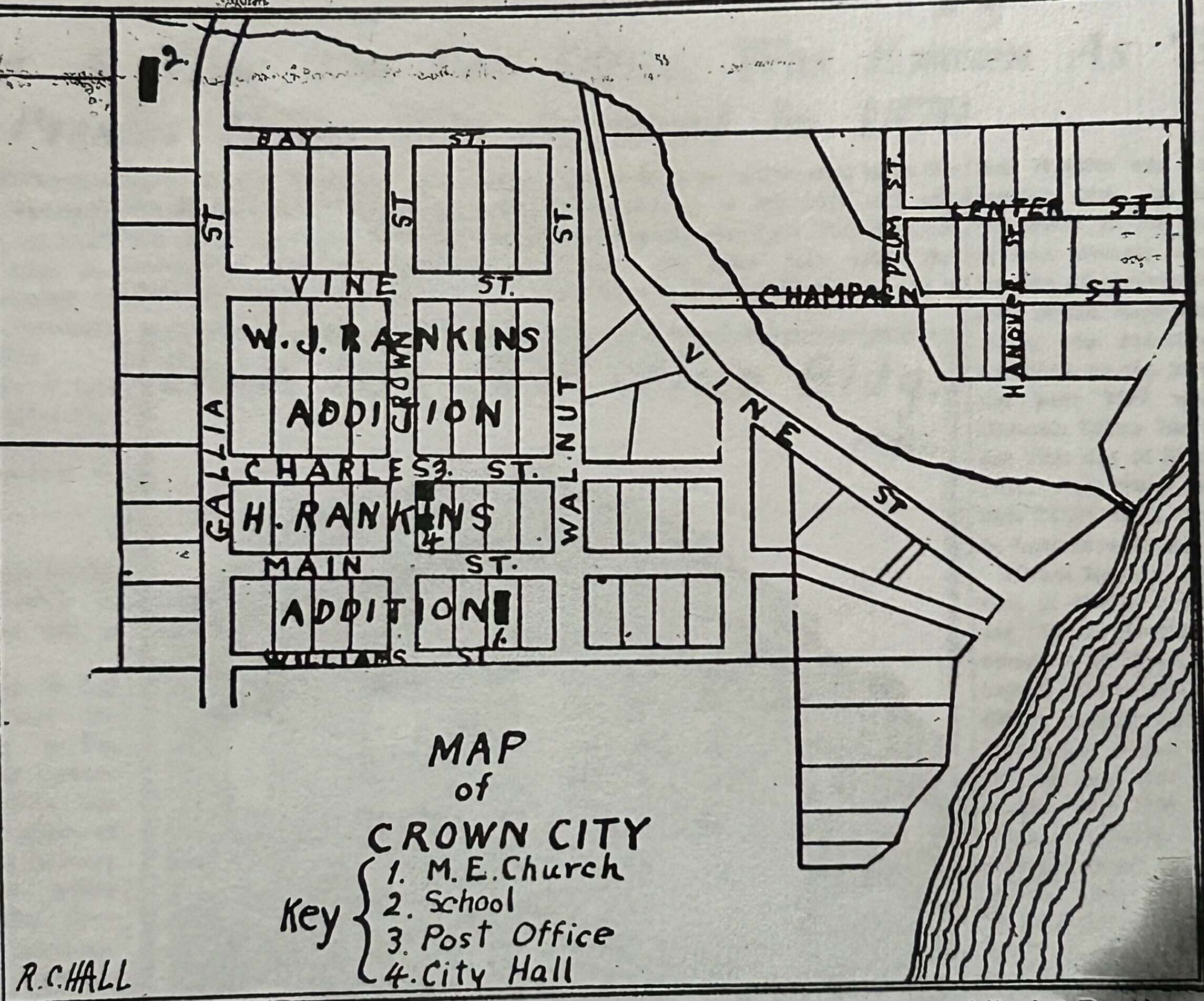
In contrast, an engineer who performs the actual work, or oversees it, is said to “survey” the plot or land in question. Eventually, this is what occurred in the affair under consideration. However, there is a second explanation for this apparent discrepancy, and it may in part account for it. This can be seen by examining a map of Crown City, which shows the original plot and the various additions to the village.
This suggests that the town was initially established near the mouth of a small creek and along the banks of the Ohio River. The map that we have seen before us was created by a reputable company around 1870, and it shows an addition to the part of town we have just mentioned.
Two additions are written down: the W. J. Rankins addition and the H. Rankins addition. Thus, the claim that Hiram Rankin laid out the town might have been based upon the fact that a comparatively large part of it was contained in his part.
Moreover, the Rankins’ additions are located in the central part of the town today, specifically the area on the high ground east of the state highway.
The first post office in Gallia Township was set up at Mercerville and operated by Joseph N. Larry, according to the best available information. From the same source, we find that Saundersville, Chapman’s Mill, and Yoho became early community settlements, comprising a few homes, a mill, a store, and a post office.
However, there were never any very clear prospects of any of these places growing into anything more than a mere hamlet, except Mercerville and Crown City. For a time, there must have been a rivalry between these two; however, some of this feeling may still remain between the two communities, although Crown City has become and remains the only incorporated municipality in Guyan Township.
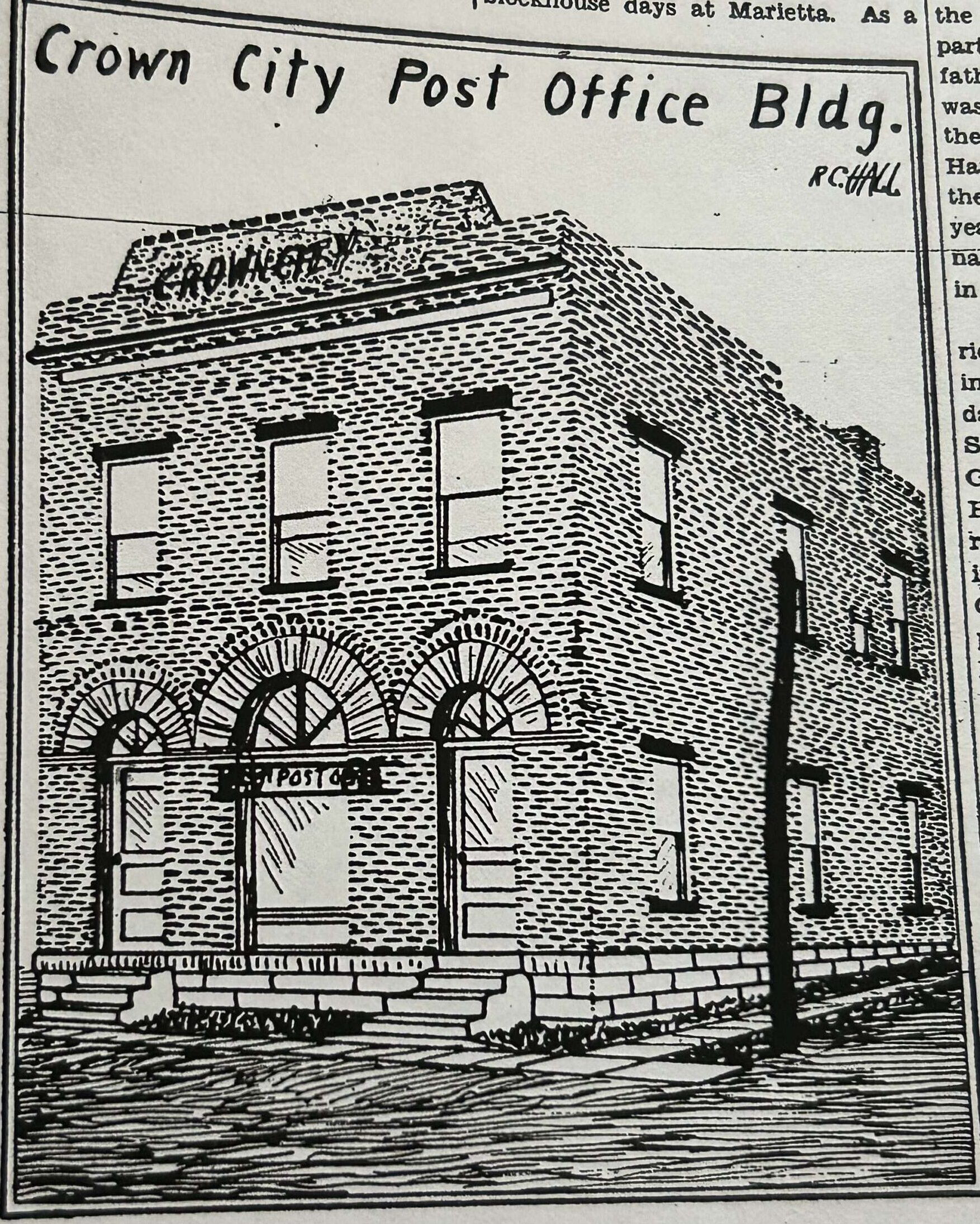
The post office at Crown City was established on August 19, 1847. And this may be considered the real beginning of Crown City, although it is not referred to as such at first. As no town yet existed there, it was necessary, however, to find a name for the post office.
In those days, if no other name could be found for a community, it was natural for people to refer to it by the name of one of the leading citizens. Thus, if most of the land on a certain hill was owned by a particular person, that person’s name was applied to the hill or the community.
Or a community might take its name from a river landing, kept by a particular farmer or trader. In this case, the bottom land at or near the site of Crown City belongs to a family by the name of Bay, and so it became commonly known as Bay’s Bottom. This, of course, referred to the rural community, not the village or town.
Its Early Growth
However, when a post office was established at the bottom, it was natural to give it the name already familiar to the surrounding citizens, so it was called Bay’s Bottom post office. The postmaster was Nelson Layne, who thus became, in the sense, the first postmaster at Crown City, or to be more exact, at what is now Crown City.
The establishment of the post office and a river landing at Crown City, or, as we have mentioned, at what is now Crown City, were the two chief events most responsible for the development of a village at this location. The two naturally went hand in hand at that time, figuratively speaking.
As the mail was carried by boat to all post offices on navigable streams, there was usually a public landing at or near every post office site. It will be noted, too, that the date of the establishment of the post office at Bay’s Bottom was not long after the settlement of Hiram Rankin in that vicinity.
It was evidently around 1850 that the village that became Crown City began to grow. For our old river guidebook, published around 1846, which mentions at least a few words about every hamlet along the Ohio River at that time, there is no mention of any settlement or landing at this place.
Moreover, there is further indication that the settlement showed few prospects of prosperity during the pre-Civil War period, as shown by the fact that the Bay’s Bottom post office was abandoned on June 21, 1859. Of course, in these days, the discontinuance of a post office may be caused by any one of several reasons, or by a combination of reasons, such as a shift in the population, a change in “star” mail routes, or the establishment or rearrangements of rural roads.
Decline in Patronage
But in those days, the discontinuation of the post office no doubt usually indicated such a decline in patronage that the government could no longer afford to keep it going, or no local parsonage could be found sufficiently interested in feeling that they could afford to take charge of it.
In this instance, as in many others, no doubt, the disturbed condition of public affairs just preceding the outbreak of the Civil War and the disruption of communications, as well as the national crisis itself, was one of the chief, if not the chief, factor contributing to the backward step in public affairs at Bay’s Bottom.
At any rate, most of the non-disabled men of Gallia County, Ohio, along with others from the north, offered their services to their country in 1861. And at least one from the Crown City neighborhood made the supreme sacrifice, Melvin Sims, having been numbered among the casualties.
However, with the return of peace, the settlement in Bay’s Bottom began to grow again. The country was entering that period of prosperity that immediately followed the war. The farmers of Guyan Township naturally began to bring their produce here for shipment, ordering the goods and supplies they wanted and needed to be shipped to this location.
Then the coming of the railroad, just across the river, offered new means of transport and travel, but called for a ferry to reach it. Such developments resulted in the reestablishment of the post office, and the inauguration of ferry service in the landing was soon made conspicuous by a wharf boat, one of those objects once so inseparably associated with almost every Ohio River city, town, and village. These developments, in turn, attracted stores and other industries, as well as churches, schools, and other institutions, to such localities.
Sought New Name
However, the increased dignity and importance of the settlement in Bay’s Bottom demanded a name more indicative of its urban nature. Or at least, so some of the community leaders appeared to think. So when the post office was reestablished on June 2, 1867, a new name was suggested. Or rather, a discussion was initiated at that time regarding a more permanent and suitable name for the post office and the settlement at the mouth of Little Creek, known as Burrell’s Run, which was named after Burrell Simms.
Meanwhile, the newly appointed postmaster, Cincinnatus B. Blake, had reestablished the office and remained in charge of it until December in the year 1868; C. A. Saidler succeeded him. The question of the permanent name for the office now became more important than it had been, as it now appeared clear that the post office was to become a permanent or definite institution in the community.
It was clear that the post office was to become a permanent or definite institution in the community. Moreover, the settlement has grown to the proportions of a village to which the somewhat indefinite name of Bay’s Bottom hardly applies.
The name Crown Point was first suggested and met with a favorable response from many of the citizens. And anyone at all familiar with the location and the topography of the place must surely admit that the name would have been quite proper for the town, which does “crown the point” of the bend in the Ohio River at that place.
Using the word crown as a verb meaning “to form the topmost part” or “to cap” something. The point might also, with equal propriety, refer to the point of the hill, which extends out, as to meet the river in its bend. However, Crown Point sounds more like the name of a position than of a town, or historically, more like a fortress than a municipality.
Friendly Contest
Anyway, the name Crown City was suggested and appealed so strongly to some citizens that it is said a friendly contest was waged for a time between those favoring the name Crown Point and those advocating the adoption of the name Crown City.
When it was discovered that another place in the state was named Crown Point, the proponents of that name were eventually disconcerted. For manifestly, it would not do to have two post offices of the same name in the same state.
And so Crown City became the new name for the post office in Bay’s Bottom. And as it would eventually have been inconvenient to have the name of the town, which was growing up around the post office, different from the office itself, Crown City became the name of the village as well.
It was on May 2, 1870, that the Crown City post office officially came into existence, according to data given by the present postmaster, W. A. Lainer. At the time of the name change for the office, Mr. Seidler was the postmaster, and he was reappointed to the position under the new name, thus becoming the first postmaster of Crown City.
On January 10, 1873, Dr. Eli G. Alcorn was appointed postmaster and held the position until April 8, 1878. Dr. Alcorn, who is now living in Columbus, Ohio, was not only postmaster of Crown City but, for a time, one of the leading practicing physicians of this vicinity and a civic and community leader to whom Crown City owes much.
It was under his leadership that the place was incorporated. It thus took its place among the municipalities of the state of Ohio, as a village legally organized and recognized under the statutes.
The men following Dr. Alcorn as postmaster of Crown City in the order of their incumbencies have been:
- Charles A. Lattin
- Miles L. Blake
- Charles G. Sims
- James M. Robinson
- Lewis E. Blake
- Charles G. Sims
- William L. Gatewood
- John G. McClure
- Charles W. McClure, Jr.
- John G. McClure
- Averill Caldwell
- William A. Lanier, the incumbent.
Mr. Lanier became postmaster on April 9, 1914, and thus has almost 24 years of faithful public service in this one position to his credit. We note that in this position, Mr. Lanier has also years of loyal public service on his record, among them an enviable record as a teacher.
Crown City, which had its beginning at the landing and along the road which used to run close to the riverbank, has expanded to include practically all the bottom between the riverbank and the hill, and stretches along the river a length of probably a couple of average town blocks or a little more.
It is challenging to estimate precisely, as a significant portion of the territory along the river, which was initially part of the town, has been lost for a long time.
For many years, Crown City was a significant shipping point for tobacco, keg wood, farm products, and other goods. A large grist mill and a copper shop stood near the riverbank, and steamboats made daily landings at the wharf.
During those days of significant river traffic and railroad traffic just a short distance away across the Ohio River, a steam ferry was operated by T. J. Jenkins, better known as “Jeff” Jenkins, between the Crown City landing and the West Virginia shore.
Ingenious Ferryman
Mr. Jenkins must have been quite an ingenious man, as well as a foresighted one and a clever businessman. For he not only ferried folks across the river but also ran a grist-mill right on his boat, so that farmers crossing the river could have their corn ground at the same time.
Even after changing conditions made a steam ferry no longer profitable, a skiff ferry was maintained as long as the railroad kept a station and handled the Crown City mail on this route.
After the railroad found it no longer helpful to support a station opposite Crown City, and the mail service was rerouted by “star” carrier from Huntington, West Virginia, there was, of course, no longer a need for a ferry at this place.
Among those who served as wharf masters at Crown City were Messrs. Layne, Rankins, Sims, Niday, Fowler, and Lanier. J. M. Hannan and James Gillingham operated the mill for some time, and various persons made barrels at the old coffee shop.
At present, Crown City has one Church, a public school, a grist mill, four groceries, two garages, a post office, a City Hall, four filling stations, a hotel, a restaurant, and a barbershop.
The homes are pleasantly situated, most of them, above the high watermark of the 1937 flood. They are, for the most part, lit by electricity, while the town itself is equipped with electric streetlights. Sidewalks have been laid along some of the main streets, while the paved state highway extends through the village. This Crown City combines many of the advantages of both city and country life, but what we like about it most is the friendliness and neighborliness of its people.
0 Comments