
Historical Ironton-A brief tour IT 30 July 1989
Article from Jul 30, 1989 The Ironton Tribune (Ironton, Ohio) We
1. Hiram Campbell House, 321 N. Fifth St. – This french empire style house is notes for its mansard roof, unsual in Ironton. Now an apartment building, it was built in the 1850s by Hiram Campbell, prominent ironmaster, state legislator and brother of John Campbell. The home was the scene of many of the city’s early social activies, including a visit from President Rutherford B. Hayes.
Newspaper article from Ironton Register on 9 May 1872: H. Campbell is putting a new verandah on his home.
2. John Campbell House, 305 N. Fifth St. – John Campbell, founder of Ironton, pioneer ironmaster and railroad developer, built this early Victorican brick in 1850. An active abolitionist, Campbell received fugitive slaves through a tunnel, which led from the Ohio River to his cellar, and hid them in two concealed rooms in his home. Today, the house is occupied by the Lawrence County Community Action Oranization. It retained many of the original features, including an impressive staircase. It is open to the public during office hours.
Newspaper article from the Ironton Register on 8 March 1894: – Sold. – The John Campbell homestead was offered at public auction, last Saturday by the Assignee, H. S. Neal, and was bought by the Trustees for the creditors, Messrs. W. A. Murdock, of Ironton, L. M. Beaman of Gallia, and A. T. Johnson, of Portsmouth. The price paid was $8,666.67, which is two-thirds of the appraised value. The property comprises nearly seven fine lots, and an elegant house of some twenty rooms or more, elaborately finished inside with massive walnut casings, and of commodious proportions throughout. The house was erected in 1850, and was remodeled in elegant fashion about fifteen years ago. Gabe Johnson, who was one of the appraisers, remarked when performing that duty that he was present once when a gentleman’s offer to Mr. Campbell of $30,000, for the property was refused. Still the appraised value is counted a reasonable price for the property now. W. A. Murdock will take the house and occupy it, after making some repairs.
3. Staab House, 416 Lawrence St. – Believed by many Irontonians to be Ironton’s oldest home, this Greek Revival was built as a farmhouse in the early 1800s. It was later altered by the addition of a wrought-iron porch. The house projects an intresting look of New Orleans.
4. Memorial Hall, 403 Railroad St. – Constructed in 1892, the city building was partially destroyed by fire in 1892. It was rebuilt in 1908 and today houses the city adminsitrative offices and police department. Only the tower and the stone facade remain from the original structure. Read about additional history here.
5. Presbyterian Church, Fifth and Railraod St. – Built in the 1800s, this brick Gothic Revival Church was the place of worship for many of Ironton’s original families. The beautiful stained glass windows are a memorial to some of these early citizens. This was the third church established in Ironton. [Additional abstracts about the church from Ironton Register newspapers are below.]
-
- IR 4 Nov. 1852 – First Presbyterian Church of Ironton – The original subscribers to the building fund of the First Presbyterian Church, who have not paid their subscriptions, are earnestly requested to hand the amount to Treasurer, H.[Hiram] Campbell, as nearly as possible, as the money is much needed.
- IR 27 July 1871 – The contract for building a parsonage for the Presbyterian Church has been let to David McLaughlin. The lot is on Olive between Seventh and Eighth streets.
- IR 27 Nov. 1873 – The repairs and additions to the Presbyterian Church have materially _____ to its appearance, and is an ornament to the place. [paper cut off]
- IR 15 Jan. 1874 – The steeple on the new Presbyterian church continue to grow. It will be some time though before the town clock blossoms on it.
- IR 7 May 1874 – The steeple of the Presbyterian church is now down and the work of strengthening the walls has begun.
- IR 10 Dec. 1874 – Leslie Alexander is at work on the dials for the Presbyterian Church.
- IR 31 Dec. 1874 – The pews of the Presbyterian Church will be sold tomorrow evening, 1 Jan.
- IR 23 June 1887 – Rev. Jos. Chester, the first pastor of the Presbyterian Church here, filled his old pulpit last Sunday morning and evening. Mr. Chester begins to show the signs of age in hair and face, but his heart seems as young as ever.
- IR 16 Nov. 1893 – The Presbyterians are raising money to put a new bell in their tower.
6. Lantem-Horn House, 605 Lawrence St. – This Federal Greek Revival cottage was built by the Lantem family in 1857 using bricks produced on Lawrence Street in the same brickyard which manufactured those used in the Campbell House. Henry Horn, a butcher, bought the house in 1891. It has remained in the possession of his descendants until recently, when it was purchased by the Lawrence County C.A.O. [Photos and additional story about the Henry Horn home coming soon.]
7. Oak Ridge, 101 S. 8th St. – This impressive home was built by W.C. Amos, an iron furnace man, and was later owned by A. R. Johnson, a prominent Ironton attorney. The inscription at the entrance to the house recalls the old Oak Ridge Furnace. The house was a socail center in the past. boasting of its own third floor ballroom. [There is some discrepancy about who actually built this house. See abstracted newspaper articles from the Ironton Register, Huntington Herald-Dispatch, and the book “Pictural History of Lawrence County” below-The Lawrence Register]
-
- IR 22 Jan. 1874 – Yesterday A.M., Mr. F. D. Norton closed a contract for the sale of his large and elegant residence on 8th street to Mr. W. C. Amos. The price was $22,500. The property is one of the finest in town, and we congratulate Mr. Amos on the splendid home he will have. Mr. Norton sells because the residence is too large for his small family. He has contracted for other choice and desirable lots and will soon erect a handsome dwelling there.
- IR 2 Apr. 1874 – W. C. Amos has moved to Ironton and occupies his elegant residence on 8th street.
- IR 19 Nov. 1874 – W. C. Amos is giving his fine residence a new coat of paint.
- IR 29 Jan. 1891 – A. R. Johnson has traded two Whitwell lots for J. W. Sayre’s residence on Olive street. There is one lot of the latter property, but a finely situated one and Mr. Johnson proposes to build a nice residence on it.
- HD 20 June 1961 -picture – Ironton Landmark Once GOP Mansion. – Thirty-sixth in a series by Curtis Bates. – Oak Ridge, the spacious home of Dr. A. Justine Payne and family on Eighth Street, was once the “GOP Mansion of Ironton.” Many visiting celebrities were entertained there when the home was owned by Attorney A. R. Johnson, who named it for Oak Ridge Furnace. The home was erected by W. C. Amos, one of the Seven “Iron Masters” who organized Big Etna, the largest blast furnace in the world in 1873. Each of the seven directors of Big Etna built a big home. George Willard built at Front and Park now the depot site; Cyrus Ellison at Fifth and Central [sic Centre] Streets, the post office site; George N. Gray at Sixth and Adams Streets, now the Edmundson home; Thomas McGovney, Sixth and Jefferson Streets – the Tracey Brammer funeral home; D. H. Clark, Fourth at Washington Streets, now the Briggs Library location and L. T. Dean at Fourth and Jefferson Streets. The lot surrounding the Payne home covered a city block between Center Street and Park Avenue on Eighth and Ninth Streets until recently when the Ohio Bell Telephone Co. exchange was erected on Ninth Street and Park Avenue.
- PHLC – picture of Mr. William Covington Amos, born 1829 in Mason Tp., LC. He and his wife built the home at 111 South Eighth Street in Ironton (ca. 1880), which was named Oak Ridge by a later owner.
8. St. Paul Lutheran Church, Sixth and Center St. – Among the older congregations in Lawrence County, were the German Lutherans, who were organized in Hanging Rock in 1844. They built their first church in Ironton in 1859. The present church, built in 1903, is a picturesque example of the architecture of smaller churches in the Ohio Valley during that period. [Additional abstracts about the church from Ironton Register and Ironton Tribune newspapers are below.]
-
- IR Aug. 17, 1854 – The walls of the Welsh Congregational Church are up, and the roof on. It will be a most comfortable and good looking edifice. Also the walls of the Baptist Church are going up. It will be the largest and finest church in town.
- IR Aug. 1884 – The Welsh Calvinistic Methodist Church became the German Lutheran Church (by 1884) and was built in 1854-1855.
- 1859 St. Paul’s is formed.
- 1867 Congregation becomes corporate body.
- IR 7 Aug. 1873 – The German Lutheran church is building a commodious frame parsonage on the corner of Centre and Seventh streets.
- IR 17 Sept. 1874 – Workmen are engaged in enlarging the German Lutheran church on Sixth street.
- IR 22 Oct. 1903 – The stone work on the new Lutheran Church at Sixth and Center streets, is about completed and the brick work will soon be under way.
- 1904 Present church constructed; Philip Hopstetter and the former Sofie Eilert were the first couple to exchange marriage vows.
- 1923 Present church redecorated.
- 1936 St. Paul begins series of radio broadcasts known as “The Lutheran Vesper Hour.”
- 1937 Flood damages walls and furniture of church. More than $3,700 spent on repairs. Three families live in the church during flood.
- 1939 New parsonage is built at cost of $5,500. Paul G. Schweickart was contractor.
- 1941 Largest increase to church membership takes place.
- 1947 Gift of new gold cross is presented to church in memory of Lena Madden.
- 1949 Altar refinished and church interior redecorated.
- 1966 The Rev. E. A. Kahle retires after 36 years as pastor.
- 1978 New Lutheran Book of Worship is used for first time.
- 1995 Dedication of new Sunday School annex.
- 2003 Amazing Grace Day Camp program begins.
- Read more at: https://irontontribune.com/2009/11/14/st-pauls-lutheran-church-celebrates-150-years/
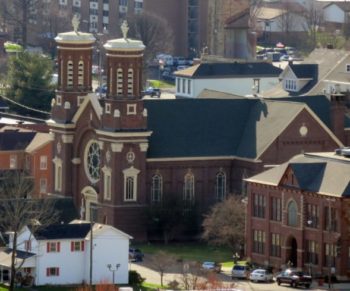
9. St. Lawrence O’Toole Catholic Church, Sixth and Center Streets – This impressive Gothic-Romanesque Church was completed in 1892. The main altar is of Mexican onyx, and the lovely glass in the windows was imported from Rome. On the ceiling is a canvas painting, done by Obediah Kover at the age of 81. The unique twin towers of the church was originally domed, but were altered to their present appearance when they were unable to sustain the weather. [Additional history of St. Lawrence Church is on The Lawrence Register website.]
10. First United Methodist Church, Fifth and Center Streets – This massivie brick church was built in 1893, replacing Spencer Chapel, the original church was of the Methodist congregation. The interior of the building is noted for its exceptionally beautiful woodwork and sanctuary furnishings. [Additional information on Spencer Chapel is on the Lawrence Register website.]
P. Old Post Office-Ironton City School Building, Fifth and Center Streets – The old post office, as it is known locally, was completed in 1913. The stone Second Renaissance Revival structure served Ironton as a post office for many years before becoming the city school administration headquarters in 1969. Additional historical material was abstracted from the Ironton Register newspaper below.
-
- The Ironton Post Office was established 14 Jan. 1850, on Third and Lawrence streets. Caleb Briggs was the first postmaster.
- IR 30 July 1868 – New Business House. – Mr. E. G. Wait is putting up a new brick house 58 feet long by 25 wide, on the Post Office lot. It is understood that Mr. John Campbell is preparing to follow with the erection of three houses immediately adjoining. Other parties owning lots there are thinking of building.
- IR 22 Oct. 1868 – Post Office – The Post Office is to be torn down to give place to a larger and more excellent structure. A small edifice is to be erected on Centre-st., nearly opposite to where the Post Office now is, to (do not have end).
- IR 27 Nov. 1873 – Capt. McQuigg has overhauled the post office, and contemplates further improvements.
- IR 24 Dec. 1874 – Capt. McQuigg has the P.O. upside down, increasing its capacity and remodeling the interior throughout.
- IR 3 Feb. 1898 – The President appointed John B. Strobel, Postmaster of the city, last Monday….
- IR 17 Feb. 1898 – Installed. – Mr. Strobel took possession of the Ironton P. O. Tuesday evening….
- IR 17 Feb. 1898 – Postmaster Strobel has appointed A. W. Abele Assistant P.M. Mr. Abele has sold his bakery to A. D. Bruce, who has engaged Mrs. Sites to conduct it.
- IR 27 Nov. 1902 – New Post office. – Now Open for Business – Elegant Quarters. – The Ironton post office now occupies the corner room on the ground floor of the Odd Fellows Temple, the change from the old quarters having been made Saturday evening and the new office opened for business Sunday morning. […gives description of the interior]
- 1914 picture of The Government Building, Fifth and Center streets. John C. Gorman, Postmaster.
- 1914 picture of Fifth Street looking north. The Post Office, Fifth and Center, the First M. E. Church, on lower corner, the Presbyterian Church in the distance, corner Fifth and Railroad Streets.
C. Lawrence County Courthouse, Courthouse Square – The stone Greek Revival “County Capital” style courthouse was completed by builder J.C. Unkefer and Co. in 1907. Recently an addition was added to its Fifth Street side. Legend says that a tree on the lawn was the site of Ironton’s first and only hanging incident, which occured on the night of 2 April 1869. [Additional historical material is found on the Lawrence Register website.]
11. Christ Episcopal Church, Fifth and Park Streets – The Episcopal congregation was organized in 1851 and they built a small frame church. In 1896, they built the present stone church.
Newspaper article from the Ironton Register on 1 May 1897 reads: – Work on the new Christ [Episcopal] Church is progressing steadily and the finishing up of the interior is now under way. Some change of plans have been made as to the interior finishing and the ceiling will be made in panels of ash instead of plaster and the ceiling will be immediately under the roof rafters instead of on he lower trusses as at first contemplated. This will give a much higher ceiling and the exposed trusses beneath will be boxed up and made ornamental. It is hoped to have the church ready for dedication by the middle of June.
12. Mehan House, 723 S. Fourth St. – This intresting brick Italinate house was contructed in the later half of the 18th century.
Also known as the J. T. Davis House, and the Robert McCrory House. Built in the 1860’s, the house is an example of French Second Empire architecture. The house is located at 723 South 4th Street at the corner of Monroe and 4th Street. The structure is known for its massive and irregular proportions. It has a tiled, mansard roof supported by exposed decorated brackets. The windows are semi-circular with plain lug sills and decorated hoodmold treatment above them. The house has a stone foundation and was one of two original houses on the block between Monroe and Madison. Ironton Register newspaper article on 20 July 1871 – J. T. Davis’ new residence is to be the handsomest house in Ironton. The location too is superb.
13. Tower House, 709 S. Fourth St. – This three-story Queen Anne mansion predates the founding of Ironton (1849).
Built in 1874 by ironmaster Frederick Norton, the owner of the Norton and Belfonte Iron works, the Tower House is a four-story gray residence with a slightly leaning tower. Notable architectural details include a cameo etched into the front door knob, fretwork molding, and floors made with yellow poplar, the same wood used in iron blast furnaces. The house is colloquially known as the Tower House because of its four-story tower, which consists of three stacked rooms with entrances from each floor, and a fourth level accessed only by ladder. The tower tilts slightly away from the house, though its roof remains parallel. [Additional information can be found on Ironton Tribune website]
14. Culbertson-Waldo House, 417 S. Fourt St. – Built in the 1850s, this lovely brick Greek Revival was the home of the Culberston family who owned a lumbering company.
-
- An Aug. 1884 article (no source or day) states that C. Culbertson’s home was built for John E. Clark in 1854.
- Ironton Register newspaper article on 25 Feb. 1892 Mr. Culbertson has put a neat wire fence about his residence, and the bad desire of boys to climb it, has already done it some damage. Boys who will injure other people’s property should be arrested.
- Ironton Register newspaper article on 8 Mar. 1894 – Death of C. Culbertson – Mr. Culbertson was 78 last Sunday. He was one of the pioneer residents of this region, having first come to this county when his father, John Culbertson, bought the Lawrence furnace property from Andrew Ellison’s heirs, and moved there from Steam Furnace, Ky. The elder Mr. Culbertson operated the furnace and accumulated considerable wealth, and Cambridge was associated with him. Later the deceased became interested in Junior furnace, and in furnace property in Tennessee. He was married to Miss Emily Rankin, who with two sons and two daughters, survive him. Some twenty years ago, Mr. Culbertson bought the Clarke homestead which has since been his home….
- Ironton Register newspaper article on 31 Oct. 1895 – Obituary of Mrs. Phoebe B. Clarke, the mother of Mrs. E. B. Willard. Mrs. P. B. Clarke was born Nov. 15, 1812, Kennett Square, Penn. Came to Cincinnati about 1830. Her maiden name was Phoebe Walton. She married Mr. Valentine in 1842, and he died in 1849. She married Mr. John C. Clarke in 1856, and came to Ironton to live in the present Culbertson residence on 4th street. Mr. Clarke died in 1858, and Mrs. Clarke continued to live there until 1868, when she took up her home with her daughter, Mrs. E. B. Willard. She died age nearly 83…
- Ironton Register newspaper article on 29 Jan. 1902 – Real Estate Deal. – Fifteen Acres in Whitwell Changed Hands Today. – Messrs. John Lucas, E. S. Culbertson and E. G. Scripture concluded a deal Tuesday, whereby they became owners of 15 acres of land in Whitwell, embracing the territory between Kemp Avenue and Pleasant street and Ninth street and the hill road forming the east corporation line of the city. The territory comprises 80 lots and it is likely that these will be platted and put on the market in the spring. The property is the John Lang farm adjoining the Warne lands.
15. Dempsey-Massie House, 407 S. Fourth St. – Samuel Dempsey, an Irontonmaster and associate of John Campbell, built this brick Greek Revival in 1855. Originally the gardens and its neighbor, the Culbertson-Waldo House, extended to Fifth Street.
-
- Ironton Journal newspaper article on 4 Dec. 1867 – Mr. D. H. Clark, of Millersport, has purchased a beautiful building site on Fourth Street, below Mr. Samuel W. Dempsey, where he is erecting a beautiful residence. W. E. R. Kemp has the contract. (location today is the library – Dempsey house now owned by Bob & Cathy Toothman-as of the year 2000).
- Ironton Register newspaper article on 30 Apr. 1874 – D. H. Clark is repairing and remodeling his residence on Fourth Strret, which presents a handsome appearance, although not yet complete.
- Ironton Register newspaper article on 9 Dec. 1893 – The pleasant home of Mr. and Mrs. D. H. Clark on south Fourth Street was the scene of a happy event Wednesday evening. The occasion was the wedding of their daughter, Mrs. Hattie Clark Simpson, to Mr. John C. Murdock…Mr. Murdock and his bride ..for their home already prepared by the groom on Center street..
- Ironton Register newspaper article on 14 Jan. 1893 – A. R. Clark Arrested – at the home of his brother D. H. Clark.
- Ironton Register newspaper article on 2 Sept. 1899 – Dennis Hayes Clark died at the family home on South Fourth Street – funeral held at the residence on the corner of Fourth and Washington Streets.
16. Marting-Lowry House, 419 S. Fifth St. – This brick home was built in the early 1900s by industrialist Col. H. A. Marting, who died before it was finished. After his death, it was occupied by his widow. It was restored in the early 1970s.
Ironton Register newspaper article on 8 June 1882 – Awarded. – The following are the bids on the contract for building H. A. Marting’s residence and stable:
House Stable
W. E. R. Kemp 2650.00 488.00
Enterprise Co. 2599.00 485.00
Evans & Chase 2604.00 448.00
T. W. Hall 2641.00 441.00
J. W. Porter 2850.00 417.50
J. W. Main 2936.00 514.00
The contracts were awarded to Enterprise Co. for the house, and to J. W. Porter for the stable.
-
- Ironton Evening Tribune newspaper article on 16 Mar. 1931 – Mrs. J. W. Lowry Dies After Long Illness – Mrs. Sarah Jane Lowry, wife of Dr. J. W. Lowry, died Saundy ..at her home at Fourth and Washington streets…Mrs. Lowry was a daughter of D. H. and Sarah Bowen Clark and was born on July 2, 1873, in the ome at Fourth and Washington, where she died. Her father Dent Clark was a pioneer in the wholesale business and he reared his family in this city….Survived by husband and one sister, Mrs. John Murdock, of Sedgwick. Five brothers and one sister preceded her in death. Her mother died four years ago. [Note from The Lawrence Register: Mrs. Lowry’s death was later determined she was murdered by her husband. This was a huge sensational story and trial that followed].
17. Bide-A-Wee House, 504 S. Fifth St. – This early 1900s Queen Anne style mansion was built of Indiana stone by irontmaster James Bird, but it was most noted as the home of the famous woman ironmaster, Nanie Kelly Wright. At one time, it was said that she was the second richest woman in the world.
The following story was written by Charles Collett and published in the Huntington Newspaper on 8 July 1966.
BIG STONE HOUSE – Norman Walton has a birthday today…The retired banker whom I have known since he was a boy living on Washington St., now occupies the beautiful stone home at Fifth and Adams Sts. with his wife Edith…Only last week, when I met Norm, he asked if I remembered when the house was built and who lived there over the years.
E. J. Bird was superintendent at Big Etna Furnace at the time of the Spanish-American War…He started to build the large home shortly after the war, but did not finish it because of the panic causing the price of pig iron to drop after the war…The big house stood half-finished until about 1910 when E. W. Bixby, cashier of the First National Bank, bought it and finished building.
Strange as it happened three bank presidents, all First National, have owned and occupied the home, Mr. Bixby (1914), Brook Capper, and now the Walton’s…Others include Mr. Bird, who never occupied it, and Mrs. Nannie Kelly Wright, a “Lady Iron Master” like Mr. Bird who lived there during the “Roarin’ 20s.”
The Bird family, before he started to build the home, resided at Third and Washington, now the Goodyear corner…The two sons, Ed and Bill, both later attended Harvard and Yale but at age 16 owned goats and wagons and often had goat races on Third St. from Vernon to Adams St…That’s the story of the big stone house as I remember it.
18. Mearan House, 917 S. Sixth St. – Also a home of Nannie Kelly Wright, this house was once located across the street from its present location. Mrs. Wright, wanting it elsewhere, had it moved to its present location.
Newspaper article from Ironton Tribune 15 March 1966 – Kelly-Mearan-St. Joseph Church Convent – Mearan Home Sale Pends To The St. Joseph Church. – Miss Arlene Mearan and her sister-in-law, Mrs. Hugh L. Mearan this morning revealed that the sale of their residence, at 912 South Sixth Street, to officials of the parish of the Saint Joseph Catholic Church, is in progress. The large 15-room Mearan residence will be used as a convent for the Sisters of St. Joseph who now reside at 918 South Sixth Street.
The home was purchased by the late I. A. Mearan and Sadye Cohen Mearan in 1922 from the late Nannie Kelly Wright, world famous iron master, who resided in the property many years.
The residence was inherited by the Mearan children, Miss Arlene Mearan and her brother, Hugh L. Mearan, who died in 1965. It is presently owned by Miss Mearan and Mrs. Hugh L. Mearan and son, Mike, a student at Ohio State University. The property, one of the show-places of this area, is rich in early history.
The Mearan residence and the Llloyd Moore residence, which have adjoining lots on the east side of South Sixth Street, were formerly located where the present St. Joseph Central Catholic High School and Convent stand today.
It was about 1910-11 that Nannie Kelly Wright sold the land to St. Joseph Parish and moved the two large frame homes across the street to their present sites. The homes were brick veneered soon after their removal to the new locations and they have remained among this city’s most comfortable and beautiful homes. Mrs. Wright, who owned iron furnaces in this section and was known as the only woman ironmaster, held an enviable reputation for her unusual and elaborate parties.
The removal of these houses on wheels across the street to the new sites were the occasion for one of Mrs. Wright’s most unique social events. It was in the present Mearan home where she resided that she entertained at an elaborate party with more than fifty ladies present, while the home was being wheeled to its new site. The social affair “on wheels” has been one of the chief conversation topics of the city throughout the past 56 or more years.
Possession will be assumed by the new owners on June 1, 1966. Mrs. Mearan said today, adding that they would vacate about May 1 and would move to an apartment at 1011 South Sixth Street which will be vacated by Mr. and Mrs. Ronald Hammonds on April 1. Mr. Hammonds and wife, the former Ellen Unger, are moving to Marion, Ohio, where he has been transferred by Goodyear, for whom he is a sales representative in this area.
19. Bay House, 620 S. Sixth St. – Captain William Bay built this Victorial Second Empire brick in the 1880s. A steamboater, Capt. Bay owned the Bay Line. The house has a unique fleur de lis on the boxed tower.
Ironton Register newspaper article on 16 Feb. 1893 – Last Saturday, the Sheriff sold to Wm. Bay the property of Geo. B. Cochrane, lot 720, on Sixth St., next to the Congregational parsonage for $1,040. IR June 26, 1902 – Plans and specifications for Capt. Bay, call for two large and beautifully designed residences of nine rooms and a bath each, to be located on either side of his fine residence on South Sixth Street. Spacious porches and balconies and shingled effects will be features of the new houses, which Captain Bay intends to rent to desirable parties. [Capt. Bay dies at his home on South Sixth Street see Ironton Daily Republican newspaper on 5 Dec. 1917].
20. H. B. Wilson House-Tracy Brammer Home, 518 S. Sixth St. – This three-storey Italian villa style house was built in the 1870s by H. B. Wilson, cashier at the First National Bank and lumberyard owner. It is said that President William McKinley gave a speech here.
-
- H. B. Wilson’s home was built in 1876. [still living there in 1884] – no source given.
21. Col. George H. Gray House, 506 S. Sixth St. – This brick Italinate mansion was built in 1866 by James Ferguson, but it was most noted for having been the residence of Col. Gray, an ironmaster, who wife, Eliza Ann Humphreys, was the granddaughter of the famous abolitionist John Rankins. It now houses the Lawrence County Historical Society’s Museum.
22. Wilson-Spears House, 422 S. Sixth St. – Dr. Wilson build this Queen Anne stryle home in the 1880s. Its irregularity and mixture of materials make it an excellent example of the architecture of its day.
Ironton Register newspaper article on 24 Mar. 1892 – Dr. D. C. Wilson will on the first of April, sever his connection with the firm of Morris & Wilson and establish his office at his residence on Sixth Street. Dr. says he has been associated with Dr. Morris as student and partner for over 20 years and their separation now is only on the account of the inconveniece of having his office so far away from his family and home.
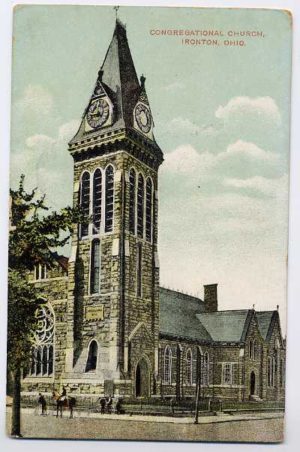
23.First Congregation Church-Geteway Baptist Church, 310 S. Sixth St. – Called the Church of the ironmaster, this American Gothic style church was built in 1873 and included in its membership many prominent Irontonians. Following are various historical newspaper articles taken from the Ironton Register.
-
- IR 29 Aug. 1872 – The Congregational Society is erecting a house, 40 x 26, on the back part of their lot, to be used as a place of worship; until the church is completed.
- IR 31 Oct. 1872 – The old Brick School House will put in a pale appearance by the side of the new Congregational Church.
- IR 31 Oct. 1872 – We observe the drawing of the new Congregational Church, at Davidson’s bookstore. The structure promises to be very fine. The plan is in strict conformity to the fashionable style of city churches, and will be the neatest ornament that has been contributed to Ironton. The foundation is now being laid, but the edifice will hardly be completed, inside of a year. The building material will be the famous Constitution stone. It will, doubtless be the finest church in Southern Ohio, outside of Cincinnati..(do not have end).
- IR 5 June 1873 – Corner Stone. – The corner stone of the Congregational church edifice was laid, last Monday. Rev. J. H. Young adjusted the heavy block, at the corner of the main spire, on Vernon and Sixth. Under the corner stone in a copper box were deposited the following articles: The church papers, the Advance, Congregationalist Independent; the local papers, Register, Journal, and Commercial; list of the members and officers of the church; names of the 1873 Graduates of the High School; various pieces of money, &c. Several persons deposited their cards, while some of the young ladies consigned to remote posterity some ambrosial locks of their own hair (do not have end.)
- IR 5 Feb. 1874 – The stone work on the Congregational Church spire is about completed.
- IR 19 Feb. 1874 – There is some talk of adorning the steeple of the Congregational Church with a handsome town clock. Then we will have two kinds of time in town, Presbyterian time and Congregational time.
- IR 5 Mar. 1874 – The new dials for the town clock have been ordered. They will be about 6’ 6” in diameter. This will make them 8” larger than the old ones [not sure where this town clock was located].
- IR 3 Mar. 1874 – The stone work on the Congregational Church tower is completed, ready for the spire.
- IR 30 Apr. 1874 – Ivy and Virginia Creepers have been planted around the Congregational church. Mr. Willard brought some sprigs of Irish ivy from Queenstown which was also set out. In a few years the church will look somewhat antique.
- IR 18 June 1874 – The spire of the Congregational Church now ascended.
- IR 18 June 1874 – The Congregational Church has pro? a fine clear-toned bell. It is the largest in town. Weighing 1300 lbs.
- IR 25 June 1874 – Last week we said the Congregational Church bell would weigh 1300 lbs. We got that information officially but it is still incorrect. The bell is to weigh 2100 pounds.
- IR 2 July 1874 – Brick masons have commenced on the tower. [was this the tower for the church? -smk]
- IR 10 Sept. 1874 – The Congregational Church has spent nearly $800 in putting four dials for a town clock on their tower. It takes nearly $50 worth of gold leaf for the letters of the dial.
- IR 10 Dec. 1874 – It is said the stone contractor for the Congregational Church cleaned an even $7,000 on his lucky bid for stonework.
- IR 24 Dec. 1874 – E. Lawton & Son will place the iron fence around the Congregational Church.
- IR 30 Sept. 1875 – Dedication. – Next Sabbath morning at the usual hour of service, the Congregational Church, of this city, will be dedicated. Rev. J. E. Twitchell, of Cleveland officiating. In the evening the installation of Rev. J. H. Young as pastor of the church will take place. – All are invited.
- IR 5 June 1879 – There is some talk of changing the seats in the Congregational Church, so as to face Sixth-st.
0 Comments